
Review · STOCKHOLM TOURS
2-Day Small-Group Basic Skills Survival Course in Södermanland
The forest has more to teach than you expect. This two-day course from Stockholm turns basic survival into hands-on practice, covering fire, shelter, water, food, plants, wildlife, and map reading in the Södermanland wilderness. I like the small maximum group of eight, and I like that guide William mixes practical work with clear explanations and plenty of humor. The main drawback is the short schedule: two days gives you a strong introduction, but not mastery.
You meet at 9:00 am at True Nature Sweden on Tideliusgatan 62, then travel by private transportation to the outdoor site. Meals, breakfast, lunch, dinner, and required gear are included, which helps justify the $480.71 price. Still, optional camping gear and backpack rental cost extra, and the course needs a minimum number of participants depending on the season.
In This Review
- Key points before you book
- Leaving Stockholm for Södermanland’s forest
- Fire, shelter, and the first survival decisions
- Finding water, food, and useful plants
- Reading the forest through tracks and wildlife
- Map reading, camp life, and working as a group
- What the two days feel like
- Is $480.71 a fair price?
- Who will get the most from this course?
- The final call: book it or skip it?
- FAQ
- Where does the course start?
- What time does the course begin?
- How long does the experience last?
- How do I reach the wilderness site?
- What meals are included?
- Is equipment provided?
- How many people can join?
- What happens if the minimum group size is not reached?
Key points before you book
- William is the central guide: His patient teaching, practical demonstrations, and easy manner help beginners feel comfortable.
- You sleep and work outdoors: The course takes place in the wilderness, not in a classroom with a token walk outside.
- The lessons cover the essentials: Fire, shelter, water, food, plants, wildlife, fishing, trapping, and navigation all appear in the program.
- Meals are part of the learning: Breakfast, lunch, and dinner are included, with fire cooking forming part of the experience.
- The group stays small: A maximum of eight people allows more time to practice and ask questions.
- Seasonal minimums matter: The course requires at least three participants from October through April and five from May through September.
Leaving Stockholm for Södermanland’s forest
The day begins at True Nature Sweden AB, at Tideliusgatan 62 in Stockholm. The stated start time is 9:00 am, and private transportation takes you from the meeting point into the wilderness area of Södermanland.
That transfer matters. You do not need to arrange your own route to a remote forest site, and the activity ends back at the same meeting point. Exact driving time and the precise outdoor site are not provided, so I would avoid scheduling a tight airport transfer or an important afternoon appointment on the return day.
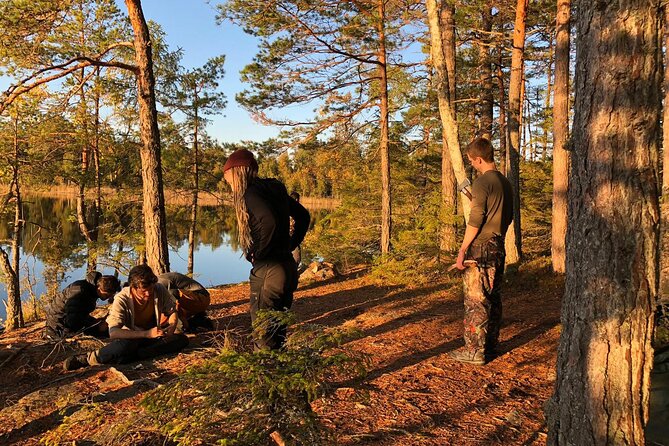
The setting is a large part of the course’s value. You are not simply shown a fire-making technique and then sent home. You work with the materials around you and begin to see the forest as a source of shelter, fuel, water, food, and information. That change in outlook is one of the strongest ideas running through the course.
The group limit of eight is useful here. Survival teaching can become vague when too many people gather around one demonstration. A small group gives you a better chance to handle equipment, test a method, and ask William to correct your technique.
More things to do in Stockholm:
- Stockholm: City Archipelago Sightseeing Cruise with Guide
★ 4.3 · 10,798 reviews - Stockholm: Skansen Open-Air Museum Admission Ticket
★ 4.5 · 3,427 reviews - Stockholm: Archipelago Boat Tour
★ 4.4 · 3,110 reviews
Fire, shelter, and the first survival decisions
The course is organized around three basic needs: fire, shelter, and food and water. The exact order may vary, but the larger lesson is prioritization. If you become lost or face a sudden outdoor emergency, you need to decide what matters first rather than rush from one idea to another.
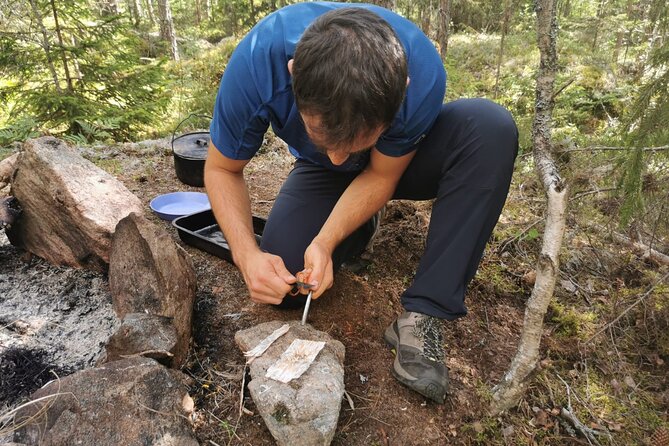
Fire is one of the most memorable practical sessions. You learn how to build one and what materials can be used. The point is not just warmth. A fire can help with cooking and make a night outdoors more manageable, so the lesson connects neatly with later parts of the course.
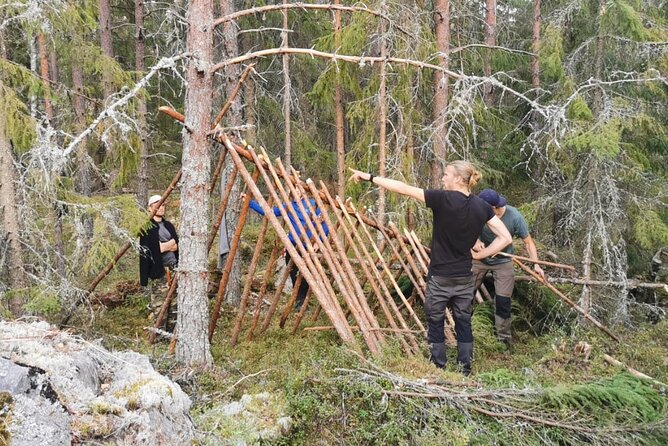
The shelter session takes the same practical approach. You learn how to build a simple shelter and which materials may help. One participant described making a shelter during the course, while another specifically praised the experience of sleeping in the forest. That suggests you should expect real outdoor conditions rather than a polished camp with every comfort provided.
This is also where you should set your expectations. The course teaches basic survival skills, not a guaranteed solution for every avalanche, blizzard, collision, or natural disaster. Two days can show you sound methods and give you practice, but repeated use is needed before those skills feel automatic.
Finding water, food, and useful plants
Food and water sessions bring a second layer to the course. You learn where water may be found and how to collect it, as well as what food might be available and how to prepare it.
The plant introduction covers edible, toxic, and medicinal plants. That is valuable, but it is also the part where you should be especially cautious. Plant identification has serious consequences, and a short course cannot turn every beginner into a safe forager. Pay close attention to William’s explanations, avoid guessing, and treat the lesson as an introduction rather than a license to eat anything that looks familiar.
Food preparation gives the subject a more enjoyable side. Meals are included, and several participants particularly enjoyed cooking over the fire. One attendee with professional cooking experience praised the food, which is a good sign for anyone worried that survival meals will mean a miserable pile of dry provisions.
Breakfast, lunch, and dinner are included in the price. That reduces the amount of planning you need to do and allows meals to reinforce the lessons. You are not only discussing how to find food. You are also seeing how food can be prepared in a basic camp setting.
The same practical logic applies to water. The course teaches collection rather than simply pointing out a stream or puddle. The provided details do not specify purification equipment or a fixed water source, so ask the provider what water treatment methods are covered if that is important to you.
Reading the forest through tracks and wildlife
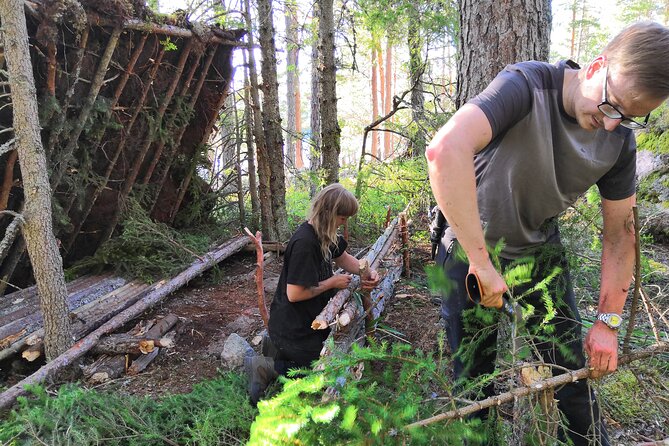
Wildlife is treated as both a source of information and a possible danger. You learn to track animals and discuss the risks they may present. Tracking helps you read signs in the forest, while the safety discussion keeps the subject grounded.
This section is less about dramatic encounters and more about awareness. You learn to notice what is around you and to think about how wildlife affects your choices. The course description does not promise sightings, close approaches, or a particular species, so book it for the tracking instruction, not for a wildlife spectacle.
Trapping and fishing are also included in the subject list. The supplied information does not state exactly which methods are demonstrated or how much time each receives. That is worth remembering when comparing this introductory course with a longer specialist program.
The broad range is both a strength and a limitation. You get a useful look at many parts of forest survival, but you cannot spend several full days on every skill. I would see the course as a sampler with genuine practice, not as professional-level instruction in trapping, fishing, botany, or navigation.
A completely different kind of day:
- Stockholm: Highlights Boat Tour
★ 4.3 · 2,542 reviews - Stockholm Pass: Save up to 50% – Includes Vasa Museum Ticket
★ 4.1 · 2,392 reviews - Stockholm: Ghost Walk and Historical Tour
★ 4.7 · 2,206 reviews - Walking Tour of Stockholm Old Town
★ 5.0 · 1,175 reviews
Map reading, camp life, and working as a group
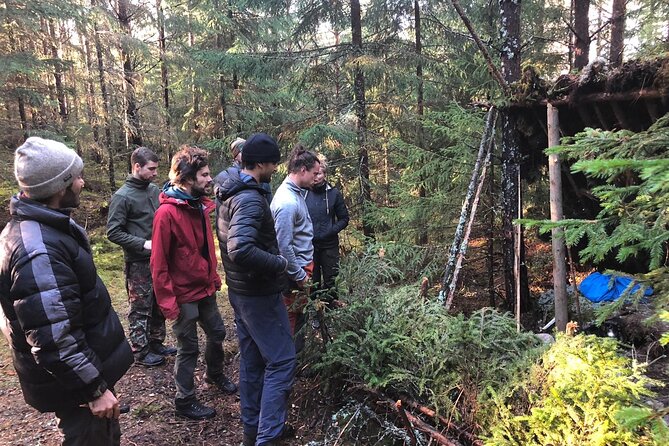
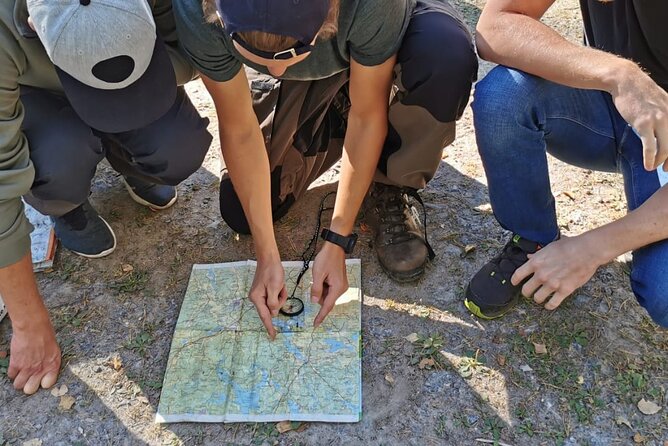
Orientation and map reading are key parts of the program. You learn to find your way through difficult situations, use a compass, and read a map. A mother and daughter who attended together specifically highlighted compass work, fire building, foraging, and shelter building, showing how accessible the teaching can be for complete beginners.
Navigation skills are among the most useful things to take home. Even if you never face a major emergency, knowing how to orient yourself can make a walk in unfamiliar woodland less stressful. The course aims to help you react correctly rather than panic, which is the right focus for an introductory program.
The encampment sessions add simple tricks for making outdoor life easier. The description does not list every camp technique, so you will learn more by doing than by expecting a detailed published schedule. Bring curiosity and patience. Some tasks may feel basic, but basic skills are exactly what you need to repeat until they become dependable.
Group survival and leadership are included too. This changes the tone from individual bushcraft to cooperation. You learn how people can divide tasks, make decisions, and respond together when a situation becomes difficult. The small group should help here, since communication is easier when everyone has a chance to take part.
What the two days feel like

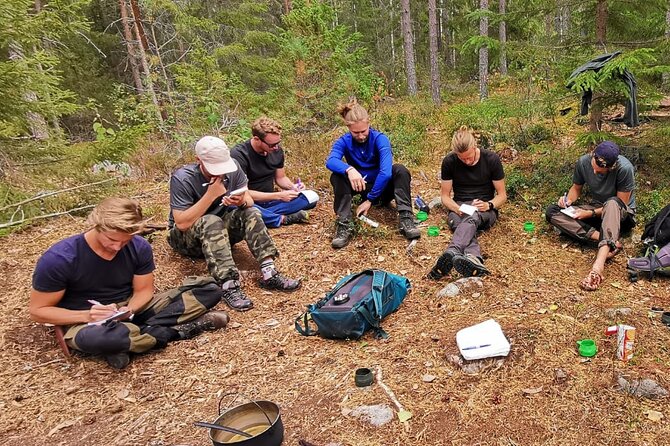
The course combines theory with practical demonstrations and practice. William is repeatedly praised for patience, clear explanations, and the amount of information he can convey in a short time. His teaching style appears to make the course friendly to beginners, including people who arrive unsure of their physical ability or worried that survival training will be overly macho.
That point matters. A survival course can sound intense on paper, especially when it mentions trapping, wildlife dangers, and emergency situations. In practice, the tone described here is more welcoming. The course is presented as fun, informative, and manageable rather than as a test of toughness.
You should still be ready for outdoor living. The course takes place in the wilderness, and sleeping in the forest is part of the experience described by attendees. Weather can change, ground conditions can be uncomfortable, and two full days outside may feel demanding even when the teaching itself is beginner-friendly.
The provider supplies all needed gear, but the details also list camping gear rental at 450 kr per person and backpack rental at 100 kr per person as optional extras. That wording creates some uncertainty. I would confirm exactly what is included and what you must bring before departure, especially if you do not own suitable outdoor equipment.
Is $480.71 a fair price?
At $480.71 per person, this is not a cheap day trip. It is priced as a two-day outdoor course with private transportation, accommodation in the forest, instruction, meals, and required equipment.
The value is strongest if you would otherwise need to rent or buy camping equipment, organize transport from Stockholm, and pay for two days of specialist teaching separately. Breakfast, lunch, and dinner are included, so your food costs are largely covered. The small group also matters because you are not paying for a large, passive demonstration.
The value is weaker if you want only a short forest outing or a polished camping weekend. This course asks you to work, learn, and sleep outdoors. You are paying for skills and guided practice, not hotel comfort or sightseeing.
The price also needs to be viewed alongside the course’s limits. The program covers many topics in two days, but it cannot offer extended mastery. If you already know how to navigate, build shelters, forage safely, and make fires, you may find the basic level too introductory. If you are starting from zero, the wide range of subjects makes the cost easier to defend.
Alcoholic drinks are not included, and travel insurance is your responsibility. The activity offers free cancellation up to 24 hours before the start time. If the minimum group size is not reached, you are offered another date or experience, or a full refund.
Who will get the most from this course?
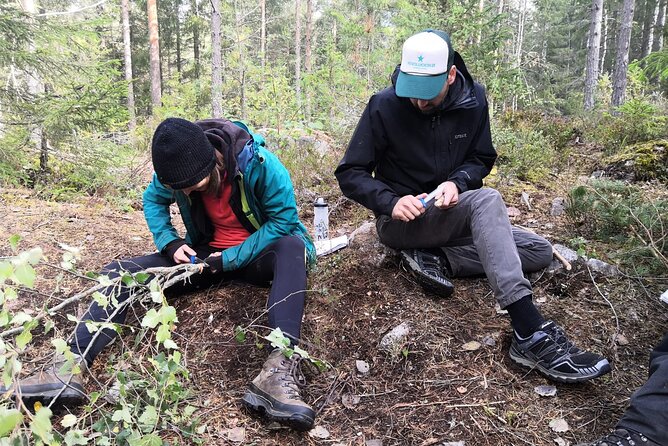
I would recommend it to beginners who want a serious introduction without committing to a much longer expedition. It suits solo visitors, couples, friends, and families who enjoy learning by doing. The mother and daughter example is useful here: you do not need to fit a rugged outdoors stereotype to take part.
It is also a good fit for anyone who wants to change how they see nature. The course encourages you to notice plants, animal tracks, water sources, and useful materials rather than treating the forest as scenery between two points.
You may prefer another option if you need advanced instruction, a fixed timetable, private coaching, or detailed training for a specific emergency. The course mentions many emergency scenarios, but the actual focus is basic forest survival. You should not assume it provides specialist avalanche, disaster-response, or medical training.
Season matters. From early October through late April, at least three participants are required. From early May through late September, the minimum rises to five. If your dates are fixed, check availability before making nonrefundable plans.
The final call: book it or skip it?
Book this course if you want a practical, friendly introduction to forest survival and are happy to spend two days outside. The strongest reasons are the small group, the broad set of skills, included meals and transport, and William’s patient teaching style.
Skip it if you want a relaxed camping holiday, a narrow advanced course, or a guaranteed wildlife encounter. The schedule is short, the program covers a lot of ground, and some equipment costs need clarification. For a beginner who wants to build confidence, cook over a fire, sleep in the forest, and leave with useful skills, this is a well-rounded choice near Stockholm.
FAQ
Where does the course start?
It starts at True Nature Sweden AB, Tideliusgatan 62, 118 69 Stockholm, Sweden.
What time does the course begin?
The stated start time is 9:00 am.
How long does the experience last?
The course lasts approximately two days.
How do I reach the wilderness site?
Private transportation is included from the Stockholm meeting point. The activity ends back at the same meeting point.
What meals are included?
Breakfast, lunch, and dinner are included.
Is equipment provided?
All needed gear is included. Optional camping gear rental is listed at 450 kr per person, and optional backpack rental is 100 kr per person, so confirm which items you need before departure.
How many people can join?
The group has a maximum of eight participants.
What happens if the minimum group size is not reached?
From early October through late April, at least three participants are required. From early May through late September, at least five are required. If the course is canceled for this reason, you are offered a different date or experience, or a full refund.
Just added in Stockholm
- Wolf and Wildlife Tracking in Sweden★ 5.0 · 1 review
- World War II Stockholm Old Town Walking Tour and Army Museum★ 4.6 · 4 reviews
- Viking History Half-Day Tour from Stockholm★ 5.0 · 1 review
- Stockholm Old Town Walking Tour + Archipelago Cruise★ 5.0 · 1 review
- Wine tasting in Old Town Stockholm★ 5.0 · 1 review
- Wolf and Wildlife Tracking in Sweden★ 5.0 · 9 reviews
- Scandinavian Art, Architecture and Design Tour in Stockholm★ 4.5 · 11 reviews
- Voyage of the Vikings: Guided Exploration Through Sweden’s Past★ 5.0 · 2 reviews
Stockholm Tours, compared.
City Archipelago Sightseeing Cruise with Guide
Read our review →


Stockholm Pass: Save up to 50% – Includes Vasa Museum Ticket
Read our review →


The Original Stockholm Ghost Walk and Historical Tour – Gamla Stan
Read our review →Browse the lists this tour appears in