
Review · UPPSALA TOURS
Uppsala bloody history 1h- racial biology, 18th century plague, 19th century prostitution etc.
The past is not always polite. This one-hour Uppsala walking tour looks at the city’s neglected and troubling stories, from the 18th-century plague and poor neighborhoods to racial biology, prostitution, slave trade, forced sterilization, and religious persecution. I like its willingness to tackle subjects that many city tours avoid, and I like that the guide connects old events with tensions still felt in society today. The main drawback is that the tour is short, so several complicated subjects receive only a brief explanation.
You’ll walk through central Uppsala with a small group of no more than 20 people, using the streets, cathedral, and university buildings as your classroom. The route includes some walking between stops, and the subject matter is serious. If you prefer royal architecture, famous scholars, and cheerful anecdotes, this may feel heavy. If you want a more honest look at Sweden’s past, it offers strong value for $36.58.
In This Review
- Key points to know before booking
- Why this Uppsala walk feels different
- Starting near Riddartorget and finding the group
- Svartbäcksgatan and the poor side of Uppsala
- Dragabrunnsgatan and Uppsala’s former red light district
- St. Erik’s Square and the plague years
- The cathedral, Dean’s House, and religious persecution
- Gustavianum, anatomy, and the abuse of science
- What the tour does well, and where it falls short
- Is $36.58 a fair price?
- Who should book Uppsala Bloody History?
- Final booking advice
- FAQ
- How long does Uppsala Bloody History last?
- Where does the tour start?
- What time does the tour begin?
- Where does the tour end?
- How large is the group?
- Is admission to Gustavianum included?
- What subjects are covered?
- Is the tour suitable for people with limited mobility?
- Can I cancel for a full refund?
Key points to know before booking
- A one-hour look at Sweden’s darker past: The tour covers plague, poverty, prostitution, slavery, racial biology, religious persecution, anatomy, and forced sterilization.
- Several stops are outdoors: You walk through Svartbäcksgatan, Dragabrunnsgatan, St. Erik’s Square, the cathedral area, and streets near Linnéträdgården.
- Gustavianum is discussed, not included as an admission visit: The entrance ticket is not included, and the tour information gives about 10 minutes to this part.
- The group is limited to 20 people: That is small enough for questions, which matters on a tour built around explanation rather than sightseeing alone.
- The subject matter can be disturbing: Stories concern executions, plague deaths, discrimination, medical abuse, prostitution, and state policies against people labeled defective.
- The guide can add local detail: Guide Owe has been praised for answering questions and mixing serious material with lighter facts. Jonathan describes this as one of the tours he considers especially important.
Why this Uppsala walk feels different
Uppsala is often presented through its cathedral, university, royal connections, and famous intellectuals. This tour turns the camera toward people and institutions that are easier to ignore: the poor, the imprisoned, religious dissenters, sex workers, plague victims, and people harmed by official ideas about race and disability.
That change of focus is the main reason to book it. You are not simply hearing a list of gruesome stories. You are being asked to look at how respectable institutions, churches, universities, and government offices could take part in cruelty. The setting matters because the stories happened on ordinary streets and around familiar landmarks.
I also like the balance described by the guides. The subject is dark, but the walk is not presented as a nonstop horror show. One guide answers questions and adds lighter facts, while another explains that the aim is to combine seriousness with brighter parts of Uppsala’s past. That balance should help the tour feel thoughtful rather than sensational.
The title may suggest a tour focused only on murder or medieval violence. In practice, its meaning is broader. The blood comes from disease, punishment, warlike systems of trade, medical practices, and policies that harmed people over many years. This is social history with a sharp edge, not a ghost walk.
More History Tours in Uppsala:
- Stockholm Viking History Full Day Tour to Sigtuna + Uppsala
★ 4.6 · 218 reviews - Stockholm: Ghost Walk and Historical Tour
★ 4.7 · 2,206 reviews - The Original Stockholm Ghost Walk and Historical Tour – Gamla Stan
★ 4.5 · 1,165 reviews
Starting near Riddartorget and finding the group
The stated starting point is Riddartorget, or Knights’ Square, on Biskopsgatan, with a start time of 3:00 p.m. Another description refers to an introduction outside the main entrance of Uppsala City Library, and the listed end point is the library on Svartbäcksgatan. Because those details do not match perfectly, I would check the final confirmation carefully before setting out.
That small practical issue matters. A one-hour tour leaves little spare time if you wait at the wrong square or library entrance. The booking confirmation is sent at the time of reservation, so use that document as your final guide for the exact meeting place.
The tour is supplied as a mobile ticket, and all fees and taxes are included. Gratuities are not included. The group limit is 20, and the walk requires a moderate level of physical fitness. Service animals are allowed.
Svartbäcksgatan and the poor side of Uppsala
The opening section focuses on Svartbäcksgatan, the poor parts of Uppsala, and the plague that struck the city from 1709 to 1712. The listed timing gives about 20 minutes to this section, making it the longest individual stop.
This is a useful beginning because it establishes the tour’s main idea: history is not only found in grand buildings. Streets connected to daily life can also reveal how a city treated people during crisis. A plague story becomes more meaningful when linked to poverty, overcrowding, fear, and unequal hardship.
You can expect the guide to explain the setting rather than simply point out a plaque. The stop is outdoors, and admission is free. Since the tour lasts roughly one hour, you should not expect a full lecture on the plague or a detailed medical history. Instead, this part gives you a compact account of how disease and poverty affected Uppsala.
The old city setting may look peaceful today. That contrast is part of the experience. You are asked to imagine the same streets during a period when illness, poor living conditions, and limited medical understanding could change the course of a family’s life quickly.
Dragabrunnsgatan and Uppsala’s former red light district
The walk continues through streets near Linnéträdgården, including Dragabrunnsgatan, where Uppsala’s 19th-century red light district and brothels were located. The tour also addresses alcohol problems and poor neighborhoods.
This stop adds a different kind of social history. Instead of focusing on a single disaster, it looks at urban life, poverty, sexuality, and public morality. A red light district was not an isolated curiosity. It was tied to housing, work, drinking, policing, and the way respectable society separated itself from people it preferred not to see.
I like this part because it makes the city feel less polished and more real. The streets are not just routes between attractions. They were places where people worked, struggled, drank, made money, and faced judgment.
The subject can be handled badly if it becomes a parade of scandalous details. The supplied description suggests a broader approach, with prostitution placed alongside poverty and alcohol problems. That is the right frame. You should expect social context rather than a lurid story designed only to shock.
More Uppsala trips:
- Cube of Art Uppsala Museum of Interactive Art
★ 4.5 · 69 reviews - Roofwalking on the worlds greatest pink castle!
★ 5.0 · 15 reviews - Uppsala: City Highlights and Hidden Gems Walking Tour
★ 4.7 · 12 reviews - Best of Uppsala: Private Walking Tour with a Local
★ 3.9 · 7 reviews
St. Erik’s Square and the plague years
St. Erik’s Square is connected with the plague in Uppsala from 1709 to 1712. The route information places this subject alongside the discussion of Svartbäcksgatan, so the exact order may depend on the guide and the group’s pace.
This is one reason the walk is best understood as a connected route rather than a series of separate attraction visits. The guide uses different parts of central Uppsala to show how disease, poverty, and urban life overlapped.
You may find the plague section especially useful if you have already seen Uppsala’s cathedral and university buildings. It provides a reminder that the city’s past included ordinary people facing frightening conditions, not only scholars and church leaders.
The drawback is the limited time. A 10-minute stop, or a short explanation while walking, cannot cover every cause and consequence of the plague years. I would book this for a clear introduction and a new way of reading the city, not as a specialist study of 18th-century medicine.
The cathedral, Dean’s House, and religious persecution
Near Uppsala Cathedral and the Dean’s House, the tour turns to the persecution of dissenting Christians and atheists during the 19th century. This stop lasts about 10 minutes and is free to experience from outside.
The setting gives the subject extra weight. A cathedral is usually presented as a symbol of faith and continuity. Here, the discussion also considers what happened to people who did not fit the officially approved religious order. That includes dissenters and atheists, whose beliefs could bring social or legal pressure.
This section is valuable because it complicates the usual story of Sweden as a modern, tolerant country. Present-day reputation should not erase earlier restrictions or punishments. The tour’s wider purpose is to show how a society can speak about virtue while excluding people who fall outside accepted norms.
The cathedral area is also where the tour discusses the Swedish Institute of Racial Biology, which operated from 1920 to 1958. You will hear about what went on inside the institute and how racial classification was treated as an official field of study.
That is a serious subject, and the short time makes the guide’s clarity important. The tour does not present racial biology as an odd side note. It places the institute among Sweden’s institutions and asks you to consider how scientific language can be used to give harmful ideas authority.
Gustavianum, anatomy, and the abuse of science
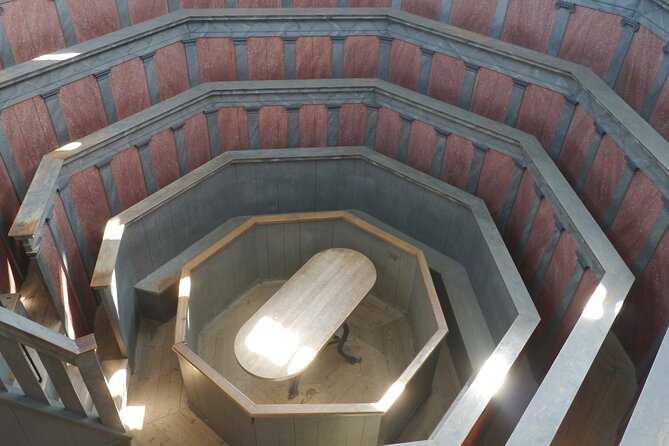
At Gustavianum, the Uppsala University Museum, the tour covers the anatomical institution, phrenologists, and the rules that determined which crimes could result in a person ending up under the knife. Admission to Gustavianum is not included, and the route gives about 10 minutes to this part.
You should not assume that this means a full museum visit. The experience is primarily a walking tour, and the Gustavianum stop functions as a place to explain university medicine and 19th-century ideas about the body and the mind.
The discussion of phrenology is especially revealing. Phrenologists claimed that a person’s character could be read through the shape of the skull. The idea has long been discredited, but the tour uses it to show how confident scientific language can support prejudice.
The anatomical material is darker. The guide explains the rules governing which crimes could lead to dissection. That detail shows how punishment could continue after death and how the bodies of executed people could become useful to institutions. It also raises questions about consent, class, crime, and who had control over a dead body.
The tour also addresses the forced sterilizations of the 1940s. This is among the most important subjects on the route because it links earlier theories about race and human worth with direct state action against people judged undesirable.
I would not book this part expecting graphic demonstrations. The provided details point to explanation and historical context. Still, the material can be upsetting, especially for anyone sensitive to medical abuse, eugenics, or state control over reproduction.
What the tour does well, and where it falls short
The strongest feature is the guide’s ability to connect place and policy. You hear about poverty on the street, religious control near the cathedral, racial science around the university, and medical authority at Gustavianum. The route makes large ideas concrete.
The second strength is the range of subjects. In one hour, you move from plague and prostitution to slavery, anatomy, race, religion, and sterilization. That is a lot. It gives you a strong set of questions to explore later, even if no single topic receives a full treatment.
The small maximum group of 20 is another plus. A guide can answer questions more easily than on a large coach tour, and one description specifically praises the guide for doing so. The experience seems suited to people who want conversation, not just a recorded speech.
The limits are just as clear. The tour covers the 17th-century slave trade, 18th-century plague and poverty, 19th-century prostitution and persecution, and 20th-century racial biology and sterilization. That span is enormous. You will receive an overview, not a detailed academic course.
The tour is also not designed for every mood. Its stories include death, discrimination, forced medical procedures, and people treated as less than human. I would avoid scheduling it immediately before a celebratory dinner if difficult subjects affect your mood strongly.
Is $36.58 a fair price?
At $36.58 per person, this is not the cheapest way to spend an hour in Uppsala. You can walk past the cathedral and university buildings for free. The price pays for the research, route planning, and interpretation that turns familiar streets into a connected story.
I consider the cost reasonable if you care about history, social questions, or less familiar parts of a destination. It is less attractive if you want interior access to several buildings, since Gustavianum admission is not included and the other stops are mainly outdoor locations.
The value improves if you ask questions and treat the tour as an introduction to Uppsala. The price also includes all fees and taxes, so there should not be an extra service charge built into the booking. Gratuities are separate.
The experience is often booked 34 days in advance on average. That suggests planning ahead is sensible, particularly if you have a fixed afternoon in Uppsala. Free cancellation is available until 24 hours before the start time, subject to the stated minimum-group condition.
Who should book Uppsala Bloody History?
I would choose this tour if you want:
- A serious alternative to standard cathedral and university sightseeing
- Local stories about poverty, prostitution, plague, and religious control
- An introduction to Sweden’s racial biology and forced sterilization policies
- A small-group walk with time for questions
- A short activity that fits into an afternoon in Uppsala
I would think twice if you want a light stroll, a long museum visit, or a tour focused mainly on architecture. The pace is likely to feel brisk because so much ground is covered in about an hour.
A moderate level of physical fitness is required. The route is a walking experience, and the details provided do not suggest transport between stops. Bring a mobile ticket, arrive at the confirmed meeting point, and allow enough time to walk through central Uppsala.
Final booking advice
Book Uppsala Bloody History if you want the city’s uncomfortable questions, not just its beautiful buildings. The guide-led format gives you context that you would miss by walking these streets alone, and the small group makes it easier to ask about difficult subjects.
I would especially recommend it to repeat visitors and people already familiar with Uppsala’s cathedral or university. You will see those places differently after hearing about dissent, racial classification, anatomy, slavery, and sterilization.
Skip it if you are looking for cheerful sightseeing or a detailed museum admission. For a thoughtful one-hour introduction to the parts of Sweden’s past that are often left out, the tour offers a memorable and fairly priced choice.
FAQ
How long does Uppsala Bloody History last?
The experience lasts approximately one hour.
Where does the tour start?
The stated meeting point is Riddartorget, also called Knights’ Square, on Biskopsgatan in Uppsala. Another description refers to an introduction outside Uppsala City Library, so check the booking confirmation for the final meeting instructions.
What time does the tour begin?
The listed start time is 3:00 p.m.
Where does the tour end?
The listed end point is Uppsala City Library at Svartbäcksgatan 17.
How large is the group?
The tour has a maximum of 20 travelers.
Is admission to Gustavianum included?
No. Admission to Gustavianum, Uppsala University Museum, is not included.
What subjects are covered?
The tour covers the 17th-century slave trade, Uppsala’s gallows hill, poverty, the plague from 1709 to 1712, 19th-century prostitution and alcohol problems, religious persecution, racial biology from 1920 to 1958, phrenology, anatomical practices, and forced sterilizations in the 1940s.
Is the tour suitable for people with limited mobility?
The experience requires a moderate level of physical fitness. The information provided does not give more specific mobility details.
Can I cancel for a full refund?
Yes, you can cancel at least 24 hours before the experience start time for a full refund. Changes or cancellations made less than 24 hours before the start are not accepted for a refund.
Just added in Uppsala
- Uppsala’s biggest attractions – 1h city walk in Uppsala city.★ 4.5 · 3 reviews
- Uppsala Must See 2h city walk – 2h tour of all big attractions!★ 5.0 · 4 reviews
- Swedish Lifestyle and Private Walking Tour of Uppsala★ 5.0 · 1 review
- Uppsala Scavenger Hunt and Sights Self Guided Tour★ 5.0 · 2 reviews
- Adventure parc★ 4.5 · 3 reviews
- City walk 1h – Runes and rune stones in Uppsala★ 5.0 · 2 reviews
- Guided tour 90min at Old Uppsala mounds and old Uppsala church★ 4.5 · 5 reviews
- Best of Uppsala: Private Walking Tour with a Local★ 3.9 · 7 reviews
Uppsala Tours, compared.
Stockholm Viking History Full Day Tour to Sigtuna + Uppsala
Read our review →

Best of Uppsala: Private Walking Tour with a Local
Read our review →
Guided tour 90min at Old Uppsala mounds and old Uppsala church
Read our review →
Uppsala Must See 2h city walk – 2h tour of all big attractions!
Read our review →
Browse the lists this tour appears in